Chemistry and formulation
Analytical methods, stability studies, and formulation insights can inform both compositions, with their suitability evaluated for each candidate.
We translate the metallomics research into proprietary platforms, establish their scientific and development foundations for strategic partnerships, and advance lead candidates toward commercialization.
OUR PLATFORMS:
FIRST FOCUS & LEAD PROGRAMS
Our first focus is zinc as an essential element for the functioning of over 3,000 proteins and the related cellular pathways. This enables us test our hypothesis for both, isotopically modified and isotopically natural zinc.
Zinc-64 atoms enriched >99%
Non-radioactive isotope
An enriched, intravenous zinc metallodrug candidate
Currently in clinical trials. Initial safety has been established in humans. The human efficacy for intended therapeutic uses is subject to future investigations. Preclinical studies completed for select neurological and metabolic indications.
Isotopically natural formulation
Bioactive zinc speciation
Isotopically-natural intravenous zinc chelate metallodrug
Currently preparing for initial clinical trials. Safety and efficacy for intended uses have not been established in humans.
MUTUALLY SYNERGISTIC DEVELOPMENT
Shared knowledge can strengthen both programs—from the next experiment to the next product decision. Their development is connected through three complementary areas.
Analytical methods, stability studies, and formulation insights can inform both compositions, with their suitability evaluated for each candidate.
Matched studies can help distinguish the contribution of isotope enrichment from the effects of zinc, ligand, formulation, dose, and exposure.
Findings from either program can sharpen biomarker selection, indication priorities, and study design, guiding product differentiation and intellectual-property development.
OUR MASTER PLATFORMS
Each platform validates its core technology through the lead programs while simultaneously building a sustainable pipeline of follow-on products that benefit from accumulated platform optimization and clinical data. Thus, each platform can have broader potential while its lead candidate provides a defined starting point.
Cold isotope enrichment as a therapeutic modality
ISM™ explores whether selected, enriched stable isotopes can produce biologically meaningful effects within metal-dependent pathways, and whether those effects can be translated into medicines.Lead Candidate: KLS-1 Program
KLS-1 is an isotope-targeting strategy that applies the biology-related kinetic and equilibrium isotope effects and coordination chemistry to test whether disease-specific isotopic fractionation creates a druggable vulnerability and superior efficacy.
From nutrient metal
to differentiated therapeutics
Zinc pulse therapeutic platforms explore whether brief, controlled increases in zinc exposure can modulate zinc-dependent processes to treat diseases characterized by disrupted zinc biology.Lead candidate: KLS-4 Program
KLS-4 is a staged development strategy in which it is first commercialized as an orphan hypozincemia drug, and is sequentially translated into a multi-indication differentiated therapeutic through adapting disease-specific changes in zinc biology, dose/exposure control, and efficacy validation.
PRODUCT DEVELOPMENT
Published research provides the scientific foundation. Metallomix builds on that publicly available knowledge by developing defined compositions, formulations, and therapeutic approaches, evaluating their biological effects, and pursuing intellectual property protection for differentiated innovations. This work establishes proprietary platforms and lead candidates for further development, licensing, and commercialization.
Identify actionable insights from metallomics research and define development opportunities around disease-relevant, metal-dependent biology.
Develop candidate compositions, isotopic profiles, formulations, and exposure strategies around a testable biological rationale.
Evaluate candidates using relevant models and matched comparisons to distinguish the contributions of chemistry, isotopic composition, formulation, and exposure.
Pursue intellectual property protection for differentiated compositions, formulations, methods, and therapeutic applications.
Establish lead candidates and development plans, and build partnerships for licensing, further development, and commercialization.
Future candidates will follow a clear biological rationale, suitable isotope chemistry and biology, and testable/reproducible evidence. Progress in one program does not validate every metal or disease application.
THE BIOLOGICAL FOUNDATION
Chronic diseases can involve persistent disruptions in cellular metal availability, with consequences for energy metabolism, immune signaling and tissue function. An unmet need remains for the therapies that modulate these processes in the relevant cells and tissues, with controlled exposure and measurable biological effects.
The metallome is intricately connected to other “omes”, influencing and being influenced by them through essential metal ion regulation. It is critical for protein synthesis, charge balance, DNA integrity and repair, and the structure, signaling and stem-cell function of tissues.
We see the metallome modulation as a next-generation modality for targeted chronic disease therapies: acting on a shared functional layer that connects multiple disease-relevant pathways. With this vision in mind, Metallomix investigates defined metal compositions and selected stable isotopes to translate this approach into medicines, guided by mechanistic research, biomarkers and clinical evidence.
Learn more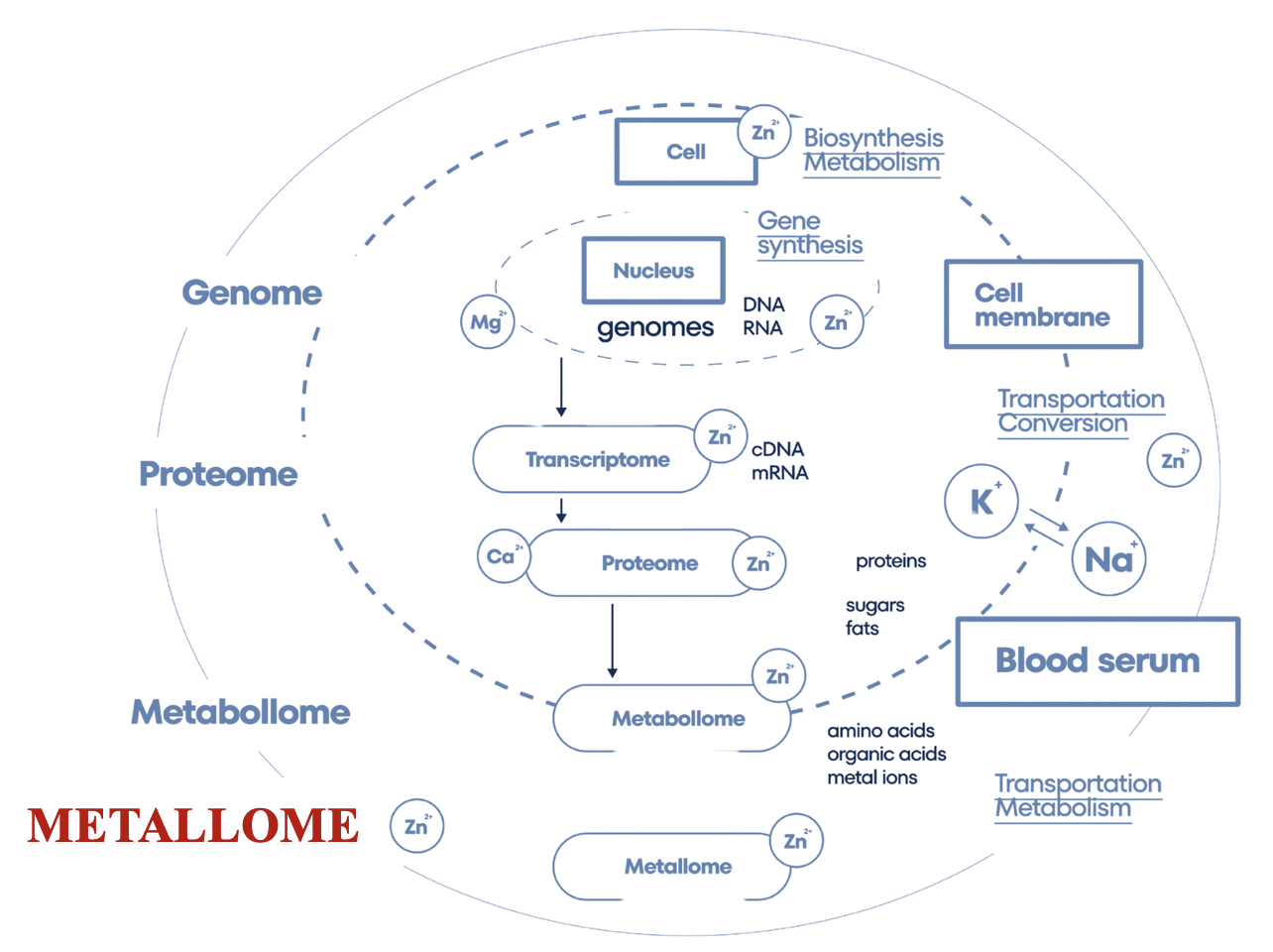 View full-size image
The term "metallome" refers to metals and metal-species in biological systems, including metal ions and metalloproteins. Understanding the metallome means understanding how these species are distributed, regulated, and used by the body in health and disease.
Disrupted metal homeostasis can cause disease or contribute to its progression. We investigate where this biology may reveal opportunities to develop new medicines. Our special focus is on cellular metal deficiencies and isotopic fractionation.
Scientific background [1–48]WE SHARE
Metallomix retains selected innovations for its own pipeline and seeks to license other significant innovations to nutraceutical and pharmaceutical companies to establish strategic partnerships for development and commercialization.
Partner with usOur intellectual-property strategy is intended to encompass bioactive compositions, pharmaceutical formulations, delivery approaches, dose and exposure regimens, and therapeutic uses, supporting development across multiple products and future candidates.
Work with us to translate the metallomics science into proprietary drugs, defined product candidates, and commercial opportunities. Collaborations can begin with intellectual property, a platform capability, a specific application, or an established development program.
License selected intellectual property to support the development and commercialization of differentiated compositions, formulations, and therapeutic applications.
Collaborate on the scientific and technical foundations of our platforms, including candidate design, formulation, analytical methods, and comparative biological evaluation.
Develop a defined application of a selected platform technology around an unmet medical need, target population, or product opportunity.
Participate in advancing a lead candidate by contributing development, manufacturing, regulatory, financing, or commercialization capabilities.
Metallomix focuses on platform creation, scientific direction, intellectual property strategy, and partnership formation. Dedicated program companies and partners can lead candidate-specific development, manufacturing, regulatory activities, and commercialization. The allocation of rights and responsibilities is defined for each program and partnership.
UNMET MEDICAL NEEDS
The metallome connects to biological processes across many diseases. Our aim is to develop therapies where a defined metal-dependent mechanism can be measured and meaningfully changed.
We define unmet medical need by identifying gaps in treatment effectiveness, tolerability, and access for specific patient populations. We prioritize opportunities where metal-dependent biology offers a testable route to better outcomes and aligns with industry objectives: differentiated products, feasible development, integration with standard-of-care therapies, protectable intellectual property, and a credible path to partnership and commercialization.
Metal availability helps shape host defense, inflammatory response, and immune-cell function.
Metal-dependent enzymes and regulatory proteins connect to proliferation, DNA maintenance, and cell-death pathways.
Metal cofactors participate in energy production, metabolic reactions, and cellular signaling.
Metal homeostasis intersects with neuronal signaling, protein function, and oxidative stress.
Metal homeostasis supports hematopoietic stem-cell function and the production and maturation of blood cells in the bone marrow.
SCIENCE & EVIDENCE
Metallomix connects the established metal biology to specific, testable claims, and transparent development milestones.
The metallome’s role in health and disease is well established in the scientific literature. Metallomix builds on this foundation to explore new ways to translate metal biology into better medicines.
Read the scientific backgroundReview the studies behind Metallomix’s initial research. Learn more about isotopic signatures and fractionation in diseases. Find science-backed information in support of our scientific stance.
Explore publicationsKeep abreast of Metallomix’s progress, from scientific research to product development. Connect with us on LinkedIn for company news, development milestones, and partnering updates.
Follow us on LinkedInIt is Metallomix’s research approach to investigating selected stable-isotope compositions as a variable in pharmaceutical design. A proposed isotope-dependent effect must be demonstrated experimentally and then evaluated for clinical relevance.
Isotopic composition is investigated alongside chemical form, ligand, formulation, dose, and exposure. It is also investigated for kinetic and equilibrium isotope effects on pharmacokinetics, pharmacodynamics, and isotopic signatures in the context of disease-modifying and therapeutic effects. Matched comparisons are needed to determine whether an observed effect is attributable to isotopic composition.
The metallome is the broader biological context. It does not imply an active program for each essential metal. Some elements have only one stable isotope, and each development opportunity needs its own chemical feasibility, mechanistic rationale, and evidence.
No. Some disorders are directly caused by defects in metal handling. In complex diseases, altered metal homeostasis may be a contributor, consequence, or marker. Therapeutic relevance and causality need to be established in the specific disease context.
Thank you for your interest in Metallomix. At this time, Metallomix is not accepting direct investment in the parent company. We welcome investment in our subsidiaries developing KLS-1 and KLS-4. Please visit Isotozin.bio and ZnA.bio to learn more about these opportunities.
PARTNER WITH US
Metallomix develops pharmaceutical and nutraceutical platforms to address unmet medical needs by investigating metal biology of the underlying diseases.
Metallomix Inc.* Publications by Metallomix team members.